Nithya Raman
is running for Mayor to make LA affordable for everyone
Progressive. Democrat. Mom. Urban Planner. Immigrant.
The political establishment wants us to believe that the status quo is all we deserve. i believe angelenos deserve better.
As mayor, my commitments are:
Make sure Angelenos have a home they can afford.
Fix the city: fill the potholes, pave the roads, plant trees, turn on streetlights, and put a park near where you live.
Protect Angelenos: from ICE, from harassing landlords, from unsafe streets, from fires and natural disasters. I’ll make sure when you call 911, someone actually shows up.
End the pay-to-play politics that have dominated the city for decades. I will not make political decisions. Only the best decisions for Angelenos.
Bring the jobs back. I’ll make it easier to start and run a business. We’ll revive small businesses, support restaurants and bars, and bring the Hollywood jobs back home.
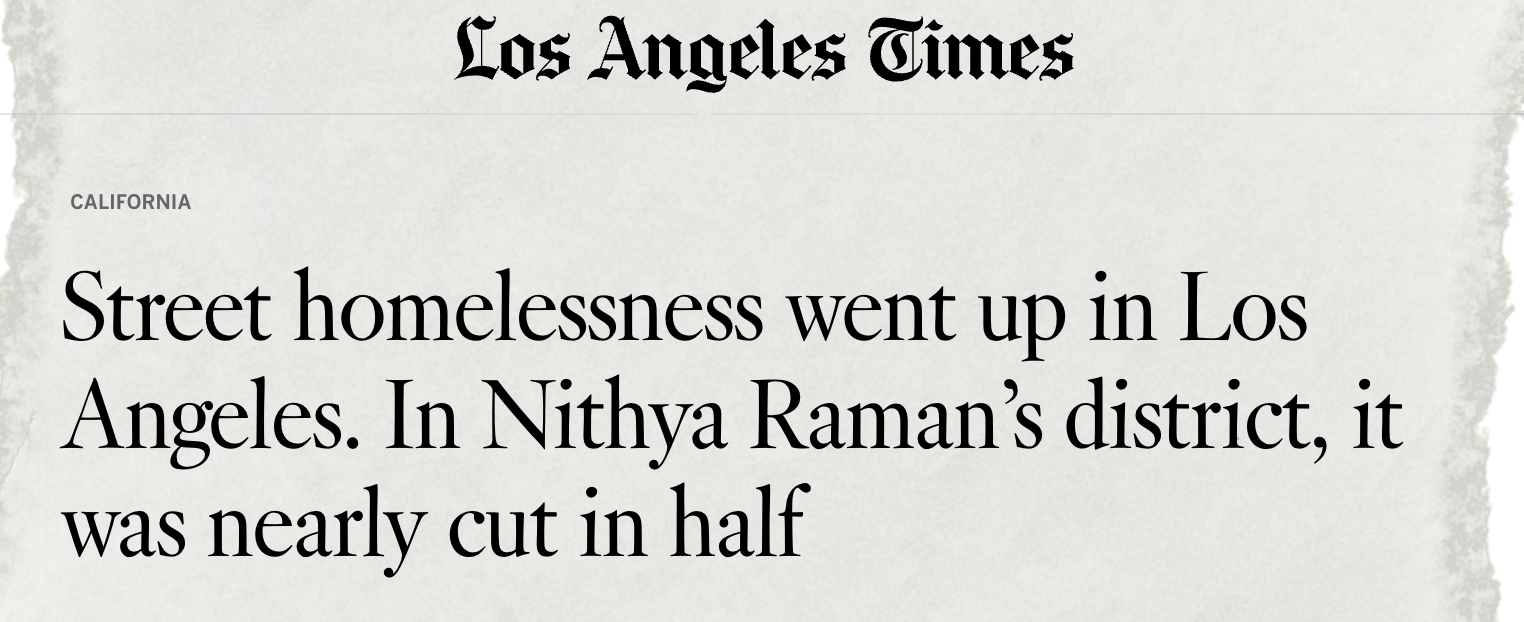
Street homelessness IS DOWN 49% in nithya’s district.
meanwhile, street homelessness across la increased 8%
This problem isn’t unsolvable, it’s mismanaged.
Another approach is possible and the results in my Council District prove it. Street homelessness is down 49% in Council District 4, and I will bring the same approach as your next mayor.
ENDORSED BY
kenneth mejia

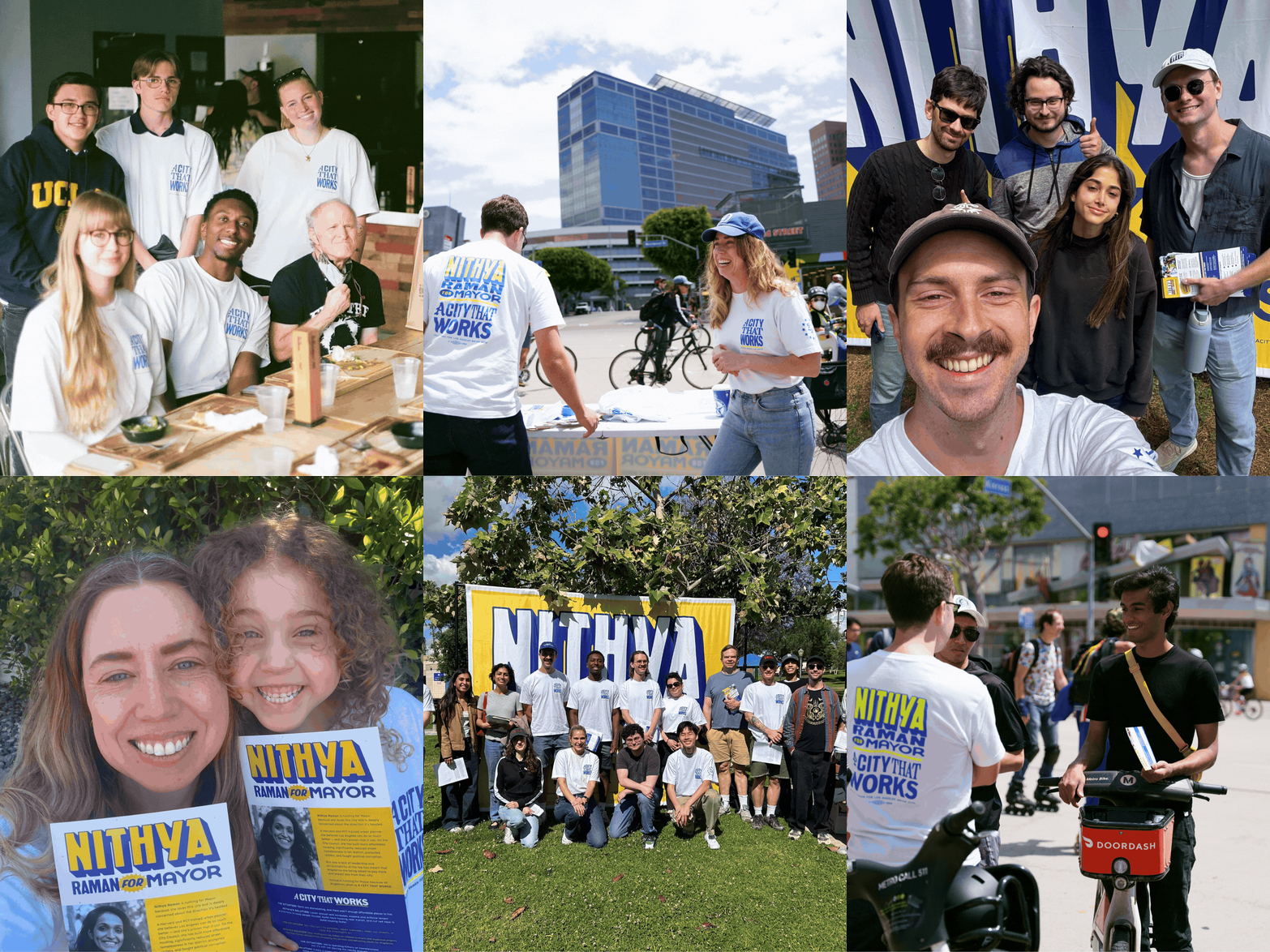
VOLUNTEER
Together, we can build a city that works.
THE PLATFORM
-
The inability to equitably and affordably house all of our residents is the compounding moral crisis of our time. It has driven our homelessness crisis, deepened segregation, and pushed working families out of the city they built.
The worst part? This crisis is almost entirely self-made. Thanks to land use policy that sharply limited where new housing can be built, and a bureaucracy that rewards indecision and delays, Los Angeles now has the fewest homes per adult of major US cities, and has the largest percentage of households who are rent burdened.
We must build much more housing to reduce housing costs. This includes housing at all income levels, everything from deed-restricted affordable housing to market rate housing to social housing to homeless shelters.
Our plan will triple annual housing construction, and allow Los Angeles to remain a city of opportunity that welcomes people looking to build their dreams here.
What we’ve done
Increased housing in Council District 4 by over a thousand units
Streamlined affordable housing projects
Created a single portal to search for affordable housing citywide (launching soon!)
Passed the Hollywood Community Plan Update and the passage of the Housing Element to create new housing capacity citywide
Passed programmatic and expenditure plans for Measure ULA and LACAHSA that will invest more than $1 billion of city and county funds to support affordable housing production, unit preservation, and eviction defense services
-
Nearly two thirds of Angelenos rent their homes. Nearly 60% of them are rent burdened, which means they pay more than 30% of their income toward housing, a larger percentage than any other major city in America.
Let’s underscore what that really means: every month, a larger percentage of Angelenos choose between paying the rent or paying for groceries, healthcare, school costs, childcare and other necessities than in any other city in America. And for 80% of the lowest-income Angelenos, more than half of everything they earn goes to rent before a single other bill gets paid.
That burden can tip into crisis with one bad month. From 2023 through 2025, the Housing Department received 245,599 eviction notices. Ninety-three percent were for non-payment of rent. The average amount owed: less than $4,000. This is a burden that falls hardest on the same people every time: renters with children, renters of color, renters with disabilities, renters in low-income communities, older renters.
What we’ve done
Capped the rent after 40 years
Passed the strongest renters’ protections in Los Angeles history
Expanded Just Cause protections to all rental units
Required landlords to file an intent to evict with the City within 3 days
Made it unlawful to evict tenants who owe less than one month fair market rent
Strengthened the Tenant Anti-Harassment Ordinance
Improved code enforcement to ensure units are habitable and in good living condition
Passed Right to Counsel and increased tenants ability to access a lawyer when facing an eviction
Passed stricter regulations for illegal home-sharing
First council office to launch a dedicated team for tenant casework
-
Every time we see one of our neighbors living and dying on the streets, we should be shocked. Instead, in Los Angeles it has become routine. The desensitization to homelessness is a moral failing and a stain on any leadership that would call itself progressive. Angelenos have voted three times in the last decade to tax themselves to respond to our city's most serious problem with housing, services, and care. But City Hall has not done nearly enough with this investment, allowing inhumane suffering to continue in one of the wealthiest cities in the world.
Los Angeles is spending hundreds of millions on homelessness every year, but we have not applied the rigor or accountability that this money demands. 40% of people moved indoors through the Mayor's signature program have returned to the streets. By failing to use our dollars, staffing, and infrastructure as efficiently as possible, we are failing the people we promised to help and squandering the compassion of voters who believed something could change. We must earn back the trust of both. If Los Angeles is going to spend real resources on this crisis — and it should — the problem must be solved.
What we’ve done
Led efforts in our district that produced some of the largest declines in unsheltered homelessness across the entire city, and brought hundreds of people indoors into safety.
Created the Bureau of Homelessness Oversight to manage homelessness spending and hold the system accountable.
Created performance data on city investments for the first time and used it to drive real results: city-funded shelter beds went from 80% to 94% occupied, and all new permanent supportive housing is now over 90% occupancy.
Created the first homelessness team at City Hall to provide consistent case management and get unhoused residents indoors quickly.
Created the city's first system to track whether homeless programs are actually working — and used it to push shelter occupancy from 80% to 94%.
Won over $2.5 million in competitive state and congressional funds to house people living along the LA River.
Worked with community partners to win more than $10 million in state funds to develop permanent housing and a treatment center for pregnant and new mothers.
-
Los Angeles is home to nearly 1.5 million immigrants — more than 1 in 3 Angelenos. Since June of last year, ordinary people have been terrorized across the city. Masked agents, with badges concealed, are snatching working Angelenos off our streets and disappearing them into detention for months without charges, without lawyers, and without due process. No one in Los Angeles should be afraid to go to work or drop their kids off at school. Los Angeles should be the strongest sanctuary city in the country. And protecting Angelenos from federal intimidation is just the start. We also owe them a city whose systems and policies are actively designed to work for them, instead of leaving families to figure it out on their own.
-
Public safety is the foundation of a functioning city. Angelenos should feel safe in their homes, walking at night, and riding transit. And when you call for help, it should be answered right away and the right response should come quickly.
In 2020, I joined Angelenos and Americans in calling for a collective reimagining of public safety. The George Floyd protests cracked open a conversation that had been closed for too long — about what keeps us safe, how that safety is delivered, and how we hold the system accountable.
In 2026, trust in our public safety system remains uneven. Too many calls for service are still unnecessarily handled by armed officers. Response times for LAPD are inconsistent across neighborhoods. And not enough is being done to prevent crime before it happens.
We will not achieve the public safety Angelenos need through the binary choice of defunding the police or defending business as usual. We must design a system that safeguards our accountability and stops defaulting to armed officers for every call for help. At the same time, the police department needs to be organized to deliver the response times and presence Angelenos deserve when armed officers are necessary.
My platform commits to three things.
First, scale unarmed response citywide and integrate it into 911. I will bring unarmed response to every neighborhood in LA and build it directly into 911 dispatch, so the right responder arrives the first time. This is how we reduce the use-of-force incidents that cause harm and drive liability costs, and deliver the holistic public safety response Angelenos have been asking for.
Second, restore accountability and trust. I will work with LAPD on deployment so that calls for help are answered in a timely fashion, hold all of our public safety responses to public performance standards through a weekly Mayor-led process, strengthen civilian oversight of LAPD by backing the Police Commission and its Office of the Inspector General, and take on the massive liability costs that stem from the department.
Third, invest in prevention. I will fund community violence intervention at scale, maintain the basics every neighborhood depends on for safety, and align enforcement with real safety risks.
This is the public safety system Angelenos deserve, and the one I'm running to deliver.
-
Over the preceding few decades, it has become increasingly difficult to raise a family in Los Angeles. LAUSD's enrollment decline reflects the deeper affordability crisis across the city. Families are leaving in droves because rent is too high, childcare is prohibitively expensive, and the basic infrastructure and services they count on for their quality of life are treated as an afterthought. No one should be forced to choose between the city they love and the family they want to build.
-
Street vendors are one of the most vibrant, visible, and essential parts of Los Angeles’ economic fabric. Tens of thousands of entrepreneurs, overwhelmingly immigrants and women, are at the helm of one of this city's most iconic small business traditions.
Yet even now, most vendors face major barriers to formal participation in the economy they help to bolster. State law effectively prohibits many stands from receiving the health permits they need to operate legally. Permitting is confusing and split across multiple agencies, compliant equipment is prohibitively expensive, and credit is out of reach. After years of organizing by vendors and community advocates, Nithya championed the City Council reform that cut LA's vending permit fee from $541 to $27.51. But the work is far from finished, and the stakes have risen since federal immigration raids have devastated vendors' livelihoods and upended their sense of safety. LA County has lost millions of dollars in revenue as a result of these raids, and many small business owners are now understandably wary of engaging with the government at all. Street vendors are not side players in LA’s economy. They are vital small business owners and cultural anchors. Vendors can run businesses that are clean, safe, and legal, but the city, county, and state need to make that possible. The city must be an active and proactive partner in their success. -
The problem
Los Angeles is losing Hollywood. Not because productions want to leave, but because we've made it too hard for them to stay. Cities around the world are funding dedicated agencies and offering aggressive incentives to take our film industry, and we have let them. This is a $30 billion industry for California that once supported nearly 150,000 jobs across the county. We've lost more than 40,000 of those jobs in recent years because we have treated it as an inconvenience rather than an asset.
The causes are structural. There is no real city film office — permitting is handled by a third-party nonprofit, and the mayor didn't appoint a dedicated film liaison until late 2025, years into the collapse. City permitting is slow and unpredictable, with no guaranteed timelines, departments that contradict each other, and fees that add up to thousands of dollars even on the smallest shoots. Neighborhood filming conditions have accumulated over decades and effectively made parts of the city off-limits to production. And recent improvements to California's tax incentives still can't match competitors who offer uncapped credits that cover above-the-line costs. We must do everything in our power to keep this industry here.
Our plan
Staff an LA Film Office in the Mayor's Office, led by people with real industry experience, and make Los Angeles a reliable partner to productions of every size.
Proactively engage studios and production companies to encourage local production, not just process permits when they come in.
Coordinate with the County and other jurisdictions so productions that cross city, county, and state lines have someone tasked with resolving inter-jurisdictional issues before they derail a shoot.
Guarantee faster, more predictable permitting with clear timelines. Institute real structural reforms within city permitting departments and FilmLA so that the bureaucracy is not standing in the way of keeping production in Los Angeles.
Lower and eliminate fees for smaller productions so indie and mid-sized projects can afford to shoot here.
Simplify neighborhood filming conditions that have accumulated over decades and made parts of the city effectively off-limits to production.
Require regular review of all filming restrictions, including Council-set special conditions and LAPD location notes, so that rules put in place after a one-time complaint don't permanently block filming on a street. Any restriction that can't be justified on current evidence should expire.
Be the loudest advocates for the most expansive possible film tax credits at the state and federal level, guaranteed multiple years into the future so that producers and studios can count on them.
The current expansion of our state tax credits to $750 million is better than before, but California is still losing to jurisdictions that offer uncapped credits, cover above-the-line costs, and provide refundable and transferable credits. For every tax credit dollar allocated, California sees $24.40 in economic output, $8.60 in wages, and $1.07 returned in state and local tax revenue, according to LAEDC.
Multi-year certainty matters as much as the dollar amount. Studios plan productions years in advance, and so do the investors building the soundstages that keep the industry rooted here.
-
Till recently, Los Angeles was thought of as a climate leader. We committed to 100% renewable energy years ahead of the state, and we announced a Green New Deal. We have lost that reputation because we have lacked the systems of accountability and the political will to actually carry out our ambitious and necessary goals. Angelenos are now paying the costs.
Building the public transit system Angelenos voted for and clearing the path for much more infill housing are two of the largest emissions-reducing levers the city has, and they are embedded in our transportation and housing platforms. This section focuses on the rest: cleaning the air that is making Angelenos sick, investing in the parks and shade that make our neighborhoods livable, developing resilience and preparing for the wildfires, heat, drought, and flooding disasters we know are coming. And perhaps most importantly, creating the implementation and accountability infrastructure that turns plans into outcomes.
-
Fixing LA’s Broken Cannabis Market
Los Angeles made a promise when voters created a legal cannabis market: businesses that followed the rules would have a fair opportunity to succeed, consumers would have access to regulated and tested products, and communities harmed by decades of cannabis criminalization would have a meaningful path to ownership. LA now has the largest municipal cannabis market in the country, but City Hall has broken that promise.
Illegal businesses remain prolific, while businesses that entered the legal market struggle to survive. Legal operators in LA carry a combined tax burden of roughly 35%, the highest of any major cannabis market in the country, while competing against a vast illegal market that pays no taxes, follows no safety standards and operates with little fear of consequences. The result: nearly 80% licensed businesses have fallen behind on local taxes and owe a combined $400 million, much of it in penalties and interest, while the City's cannabis revenue has fallen from a $123.5 million peak in 2021 to roughly $73 million today. For social equity operators, this discrepancy represents an existential threat and many have closed.
The consequences extend beyond business owners. Consumers are pushed toward untested products, neighborhoods are left with illegal storefronts, tax revenue declines, and the social-equity applicants City Hall promised to support are squeezed out.
Los Angeles cannot tax and regulate legal businesses as though they operate in a protected market while allowing illegal competitors to operate openly. We will restore the bargain: enforce the law, fix the tax structure and make the legal market work.
-
A previous fire left smoldering. A chaotic evacuation. Inadequate firefighter staffing and pre-deployment. And a Mayor who was out of the country while the fire raged. And instead of learning from its mistakes, the city tried to cover up responsibility by altering the after-action report.
The immediate aftermath was dysfunctional, and the rebuilding effort has been indefensibly slow. It has been nearly 17 months since the fires, and there is still no plan for rebuilding and no one in charge. The Mayor's "Chief Recovery Officer" left after 90 days in April 2025, and no replacement has been named since. Instead of clear accountability, we've spent millions on consulting firms and have little to show for it.
And it's not just the rebuilding that's falling short. It's the ineffective advocacy and attention to what families are actually navigating: insurance companies that wear families down until they give up, permits that take months to clear, contaminated homes you can't safely return to, and speculators making lowball offers to displaced families and businesses.
Preparing for and managing red flag conditions, emergencies, and high fire risk is an essential part of the Mayor's job. Recovery is too.
-
Angelenos are tired of sitting in traffic, feeling unsafe on their streets, and navigating broken sidewalks. We’ve voted for real change — Measure R (2008) and Measure M (2016) committed $120B to the expansion of rail and transit across the county, and Measure HLA (2024) mandated that street safety improvements happen when streets get repaved, not decades later. We’ve been waiting for City Hall to deliver on those promises with the urgency they deserve. Los Angeles moves too slowly, spends too inefficiently, plans too haphazardly, and acts too timidly to give people the transportation network they've already voted for.
-
Every week in Los Angeles, healthy animals are killed simply because there is nowhere for them to go. In 2024, over 1,200 dogs and 1,500 cats were euthanized in just the first nine months because city shelters were housing nearly twice the number of animals they were built for. City Hall responded by cutting the animal services budget, and the department operated without a permanent General Manager for nearly two years during the worst crisis in the system's recent history.
We will reduce shelter intake by expanding spay-and-neuter services and helping families keep their pets in their homes in the first place. We will make the city's shelters more humane by funding basic care and enrichment and reforming euthanasia decisions. And we will crack down on animal cruelty and neglect through targeted interventions and real accountability for Animal Services. -
Los Angeles is opening half as many new businesses as it did a decade ago, and new business formation is at a 20-year low. A key part of the problem is that our city is not a real partner to the people trying to build something in it. We've made it slow and expensive to open a business, with agencies that don't talk to each other and no obligation to move quickly. We've allowed our commercial corridors to decline, with empty storefronts, broken streetlights, and a sense that no one is tending to them. And we've left mom-and-pop businesses defenseless against a web of costs that big companies can absorb but mom-and-pops cannot.
Our plan changes that. We will make City Hall a partner instead of an obstacle by setting hard deadlines, simplifying permitting, and giving every small business a single point of contact to help them get off the ground. We will bring commercial corridors back to life by investing in the basics that make a street feel cared for, by filling empty storefronts, and by expanding nightlife and events that draw people back. And we will protect small businesses from being squeezed out by raising the tax exemption, fighting predatory ADA lawsuits, and passing protections against landlord harassment. Small businesses are what gives a neighborhood its character. And Angelenos deserve a city that acts like it knows that.
More policies rolling
out soon!

WHAT I’VE DONE
LED THE PASSAGE OF THE STRONGEST RENTER PROTECTIONS IN THE COUNTRY
CAPPED RENT INCREASES
REDUCED ENCAMPMENTS
IN MY DISTRICT
BY 54%
SLASHED RED TAPE TO
GREENLIGHT MORE HOUSING
WROTE THE CITY’S
'SANCTUARY CITY'
ORDINANCE TO PROTECT
IMMIGRANTS
FROM ICE
Established independent redistricting
in LA to end gerrymandering
Built the most
bike lanes
of any city
council district
ABOUT NITHYA
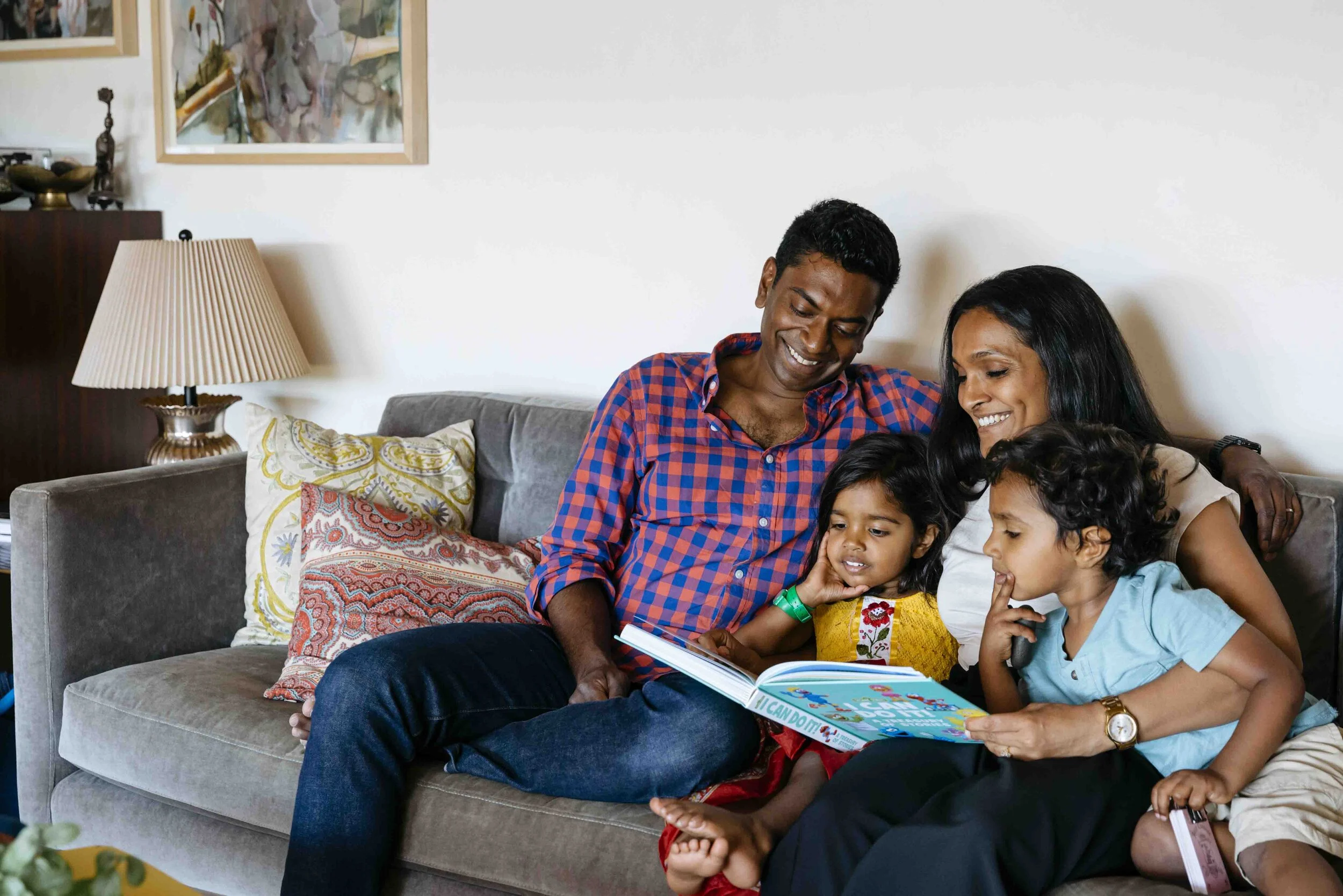
Councilmember Nithya Raman is a fearless champion for the people of Los Angeles.
Nithya Raman ran for office as a complete outsider – no political machine, no insider backing. When she defeated a sitting councilmember for the first time in 17 years, the Los Angeles Times described it as “a political earthquake.”
Her focus in office has been on creating an affordable, livable city and holding our City government accountable to deliver change.
yard signs